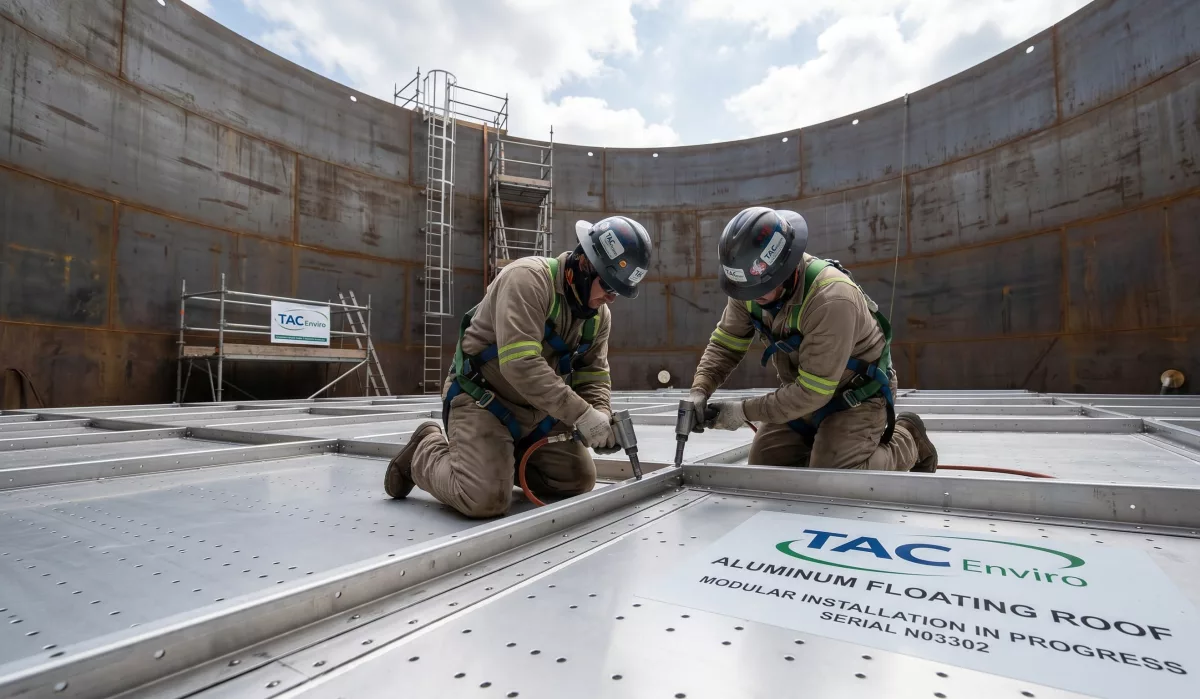

Securing volatile organic compounds (VOCs) and highly flammable petrochemicals inside bulk storage tanks requires precision engineering. The gap between a tank’s floating deck and its outer steel shell—known as the rim space or annular space—is the primary escape route for hazardous vapors. Closing this gap permanently and effectively is not just a regulatory necessity; it is a financial imperative. At the center of this protective strategy is the floating roof seal, a dynamic barrier that must constantly adapt to tank irregularities, temperature fluctuations, and chemical exposure.
When operators fail to implement robust sealing systems, the consequences escalate rapidly from invisible vapor loss to severe EPA fines, degraded product quality, and catastrophic safety risks. This comprehensive technical guide breaks down the engineering, regulatory compliance, and economic benefits of modern sealing technologies, highlighting why selecting the right components determines the long-term viability of your storage infrastructure.
The Engineering Challenge of the Annular Space
In aboveground storage tanks (ASTs) equipped with internal or external floating roofs, the deck must be able to travel vertically as the liquid level rises and falls. To prevent the roof from jamming against the tank shell, a designed clearance of generally 8 to 12 inches is left around the perimeter.
Without an advanced mechanical barrier, this open annular space acts as a chimney for evaporation. The phenomenon is driven by two main factors:
-
Working Losses: Occur when the tank is filled or emptied. As the liquid level drops, the wet tank shell is exposed to the atmosphere, allowing residual product to evaporate.
-
Standing or Breathing Losses: Triggered by daily temperature changes. As the sun heats the tank, the vapor space expands and forces emissions out through any available gap.
A high-quality sealing system mitigates up to 98% of these emissions by maintaining a continuous, tight interface against the tank wall, regardless of the roof’s elevation.
Anatomy of a Dual-Seal System
Modern environmental standards mandate the use of a dual-seal configuration for maximum emission reduction. This setup creates redundant barriers that trap vapors and protect the stored medium from external contamination.
1. The Primary Seal
The primary seal acts as the main defense mechanism, installed deep within the rim space, often touching or submerged slightly in the product.
-
Mechanical Shoe Seals: Considered the gold standard for durability. They utilize a metallic band (the «shoe») that is physically pressed against the tank wall by a series of engineered springs, levers, or compression devices. A continuous vapor-barrier fabric bridges the gap between the shoe and the floating roof.
-
Liquid or Foam-Mounted Seals: These consist of a durable polymeric envelope filled with highly resilient polyurethane foam or a heavy liquid. They are highly adaptable to tanks with severe shell deformities or out-of-roundness.
2. The Secondary Seal
Positioned entirely above the primary seal, the secondary seal (often a wiper seal) functions as a supplementary vapor barrier and a weather shield. It sweeps the tank shell clean, ensuring that rainwater, dust, and airborne debris do not infiltrate the rim space and compromise the primary seal or the stored chemical.
Deep Dive: The Superiority of the Compression Plate Seal
Within the realm of mechanical shoe seals, the method used to maintain pressure against the tank wall dictates the system’s longevity and effectiveness. This is where the compression plate seal demonstrates superior engineering.
Unlike traditional coil spring systems that can suffer from metal fatigue or uneven tensioning, a compression plate mechanism utilizes precision-formed metallic plates that act as dynamic leaf springs.
Key Mechanical Advantages
-
Uniform Radial Pressure: The plates are mathematically engineered to exert a continuous, equalized outward force along the entire circumference of the shoe. This prevents localized pressure points that cause premature wear on the tank shell while ensuring no microscopic gaps form where vapors can bypass the system.
-
Exceptional Adaptability: Industrial tanks are rarely perfectly cylindrical. Over decades of settling, welding, and hydrostatic pressure, tank shells develop ovality, localized bulges, and weld seam protrusions. The compression plate design independently flexes at micro-intervals, allowing the shoe to meticulously follow the distorted contours of the shell without losing its seal.
-
Corrosion Resistance: Because the compression mechanisms are often suspended above the aggressive liquid interface and manufactured from high-grade stainless steel or specialized alloys, they offer extreme resistance to sour crude, harsh solvents, and corrosive petrochemicals.
-
Low Profile and Weight: The streamlined design of the plates reduces the overall dead weight added to the floating roof, preserving buoyancy margins while fitting comfortably into narrow or non-standard rim spaces.
Material Science: Specifying the Right Elastomers and Fabrics
The structural metal components (shoes, plates, and bolts) are only half of the sealing equation. The flexible vapor barrier—the fabric that connects the shoe to the roof—must survive extreme operational conditions. Specifying the wrong material leads to rapid chemical degradation, embrittlement, and total system failure.
Common high-performance materials include:
-
PTFE (Teflon) Laminates: The industry benchmark for chemical inertness. PTFE offers near-universal compatibility, handling everything from crude oil to aggressive aromatics (benzene, toluene, xylene) without swelling or degrading.
-
Polyurethane (PU): Excellent abrasion resistance and flexibility, making it ideal for secondary wiper seals that must constantly scrape against rough tank walls.
-
Nitrile (NBR) and FKM (Viton): Widely used for specific petroleum distillates, offering strong resistance to heat and petroleum-based degradation.
When consulting with specialists, a thorough chemical compatibility analysis is mandatory. The exact composition of the stored product, including any trace additives, dictates the specific fabric architecture required.
Stringent Regulatory Compliance and API Standards
The design, fabrication, and installation of rim seals are strictly governed by international engineering codes and environmental regulations. Attempting to cut corners on these systems inevitably leads to failed inspections and severe financial penalties.
API 650 (Appendix C & H)
The American Petroleum Institute outlines the mechanical requirements for both external and internal floating roofs. These standards dictate:
-
The maximum allowable gap between the seal and the tank shell (measured in fractions of an inch).
-
The minimum thickness and material grades of the metallic shoes.
-
The requirement for continuous, anti-static grounding connections to prevent static electricity buildup—a critical factor in avoiding ignition of the vapor space.
EPA MACT Standards
The Environmental Protection Agency’s Maximum Achievable Control Technology (MACT) rules establish rigid emission thresholds. Facilities must demonstrate that their dual-seal configurations achieve the required VOC destruction and removal efficiency (DRE), usually upwards of 95%. Routine optical gas imaging (OGI) and physical gap measurements are legally required to prove ongoing compliance.
Installation and Commissioning Protocol
Installing these dynamic systems requires specialized knowledge. Working inside confined spaces with potentially explosive atmospheres demands rigorous safety protocols and flawless execution.
-
Tank Mapping: Before fabrication begins, engineers conduct a complete laser scan or plumb drop of the tank shell to map out exact dimensions, deviations, and weld seam locations.
-
Custom Fabrication: The metal shoes, compression plates, and fabric barriers are custom-manufactured to match the exact tank profile.
-
Mechanical Assembly: The system is bolted together—never welded inside an active tank—to eliminate hot work risks. The compression plates are tensioned to the precise specifications required to maintain an unbroken seal.
-
Gap Inspection: Once installed, technicians perform a 360-degree gap inspection using specialized probes to verify that the seal sits flush against the wall, satisfying all API and EPA tolerances.
Proactive Maintenance and Inspection Routines
Even the most robust mechanical systems require monitoring. A proactive maintenance strategy shifts the operational paradigm from reactive emergency repairs to predictable asset management.
Routine inspection checkpoints should include:
-
Visual Fabric Checks: Inspecting the vapor barrier for tears, pinholes, embrittlement, or signs of chemical attack (swelling or discoloration).
-
Tension Verification: Ensuring the compression plates retain their radial outward force and haven’t become lodged or jammed due to debris.
-
Shunt and Grounding Integrity: Verifying that all stainless steel grounding shunts are firmly attached to the shoe and in constant contact with the tank wall to safely dissipate static charges.
-
Secondary Wiper Condition: Checking the lip of the wiper seal for uneven wear, curling, or loss of elasticity.
Following API 653 guidelines for in-service and out-of-service inspections guarantees that your emission controls remain at peak performance throughout their lifecycle.
The Financial ROI of Premium Sealing Systems
Upgrading to a high-tier mechanical seal should not be viewed merely as an environmental compliance cost; it is a highly lucrative operational investment.
Consider a standard 150-foot diameter tank holding refined gasoline. An outdated, failing seal can easily allow thousands of gallons of product to evaporate annually. At current market prices, this represents a massive, invisible leak in revenue.
By implementing an advanced mechanical shoe with a precision compression mechanism, these vapor losses are virtually eliminated. The product stays in the tank, ready for sale. In most high-throughput terminals, the payback period for a premium seal installation ranges between 12 to 24 months. Over a projected 20-year lifespan, the system yields compounding financial returns while eliminating the risk of EPA non-compliance fines.
Secure Your Assets and the Environment Today
In the high-stakes environment of bulk liquid storage, hoping that outdated seals will hold up against regulatory scrutiny and chemical wear is a dangerous strategy. The integrity of your operations demands components engineered for resilience, absolute compliance, and maximum vapor recovery.
Every day a tank operates with an inferior or damaged rim seal, valuable product escapes and environmental liability grows. Protecting your bottom line starts with securing the perimeter of your floating deck. If you are ready to upgrade your infrastructure with an industry-leading floating roof seal and experience the reliability of advanced compression technology, take action now. Contact the engineering team at TAC Enviro to schedule a comprehensive tank evaluation and custom-design a sealing solution that guarantees long-term operational excellence.


