
Aluminum Floating Roofs: Design, Seals and Emission Control
Aluminum floating roofs are used in industrial storage tanks to reduce the vapor space above stored liquids and support the control of evaporation losses and volatile organic compound emissions.
Unlike a conventional fixed roof, an internal floating roof rests on or floats close to the liquid surface inside the tank. As the product level rises and falls, the roof moves with it.
The roof itself is only one part of the system. Effective performance also depends on the rim seal, deck fittings, tank geometry, stored product, inspection regime and, in many projects, an aluminum geodesic dome installed above the floating roof.
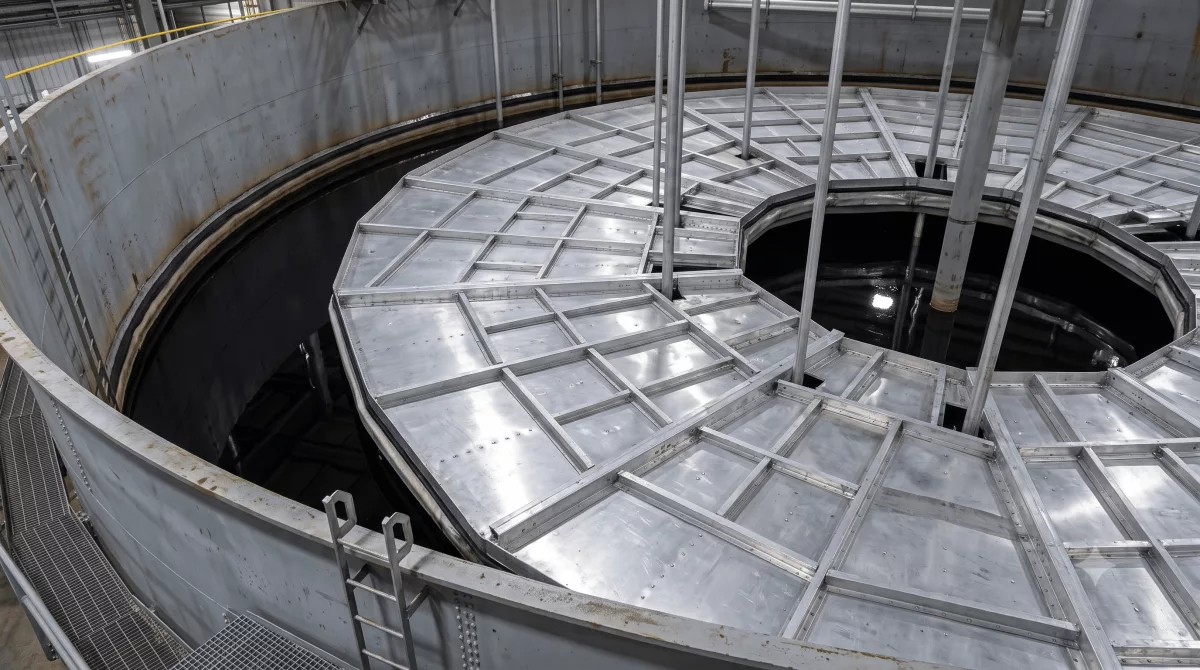
Quick answer: what is an aluminum floating roof?
An aluminum floating roof is a lightweight internal cover installed inside a storage tank. It moves vertically with the stored liquid and reduces the open vapor space between the product surface and the upper part of the tank.
- A pontoon or full-contact floating deck.
- A primary rim seal.
- A secondary seal when required.
- Seals around columns and penetrations.
- Vents, hatches and access points.
- Support legs or cables.
- An aluminum geodesic dome.
- Inspection and maintenance provisions.
- Compatibility assessment for the stored product.
- Engineering checks for the existing tank.
How aluminum floating roofs control vapor space
A fixed-roof tank can contain a substantial vapor space above the liquid. Product movements, temperature changes and pressure variations can contribute to vapor displacement.
An internal floating roof follows the liquid surface, reducing the volume of the vapor space directly above the product.
The roof does not create a perfectly sealed system by itself. Vapors can still pass through:
- The annular space between the roof and tank shell.
- Gaps in the rim seal.
- Columns and guide poles.
- Gauge wells.
- Roof legs.
- Hatches.
- Deck seams.
- Damaged membranes.
- Worn or incorrectly installed fittings.
Integrated engineering: roof design, seals, deck fittings, tank geometry and stored-product compatibility should be assessed as one complete system.
Internal and external floating roofs
Internal floating roof
An internal floating roof operates inside a tank that also has a fixed roof or dome. The upper roof protects the stored product and floating deck from direct exposure to rain, wind and other atmospheric conditions.
- Refined petroleum products.
- Chemicals.
- High-value liquids.
- Volatile products.
- Weather-protected storage.
- Fixed-roof tank retrofits.
External floating roof
An external floating roof is the main roof of an open-top tank and floats directly on the liquid surface.
Because the roof perimeter must move against the tank shell, the external floating roof requires a closure system between the roof edge and the wall.
Pontoon aluminum floating roofs
A pontoon floating roof uses buoyant compartments connected by a structural deck or grid. The pontoons provide flotation while the deck covers the liquid surface.
Low weight
Aluminum provides a favorable strength-to-weight ratio for new installations and retrofit projects.
Modular assembly
Components can be introduced through existing tank openings and assembled inside the vessel.
Seal integration
The configuration can be combined with different primary and secondary rim-seal systems.
Potential reasons for selecting a pontoon design include:
- Low structural weight.
- Modular installation.
- Access through existing tank openings.
- Compatibility with many tank geometries.
- Replacement of individual components.
- Integration with different rim-seal systems.
- Use in new tanks or retrofit projects.
Full-contact aluminum floating roofs
A full-contact roof places the underside of the deck directly against the stored liquid over most or all of its surface.
Possible advantages include:
- Reduced vapor space beneath the deck.
- Direct support from the stored liquid.
- Modular panel construction.
- Reduced number of open deck spaces.
- Suitability for selected high-volatility products.
- Integration with rim seals and tank fittings.
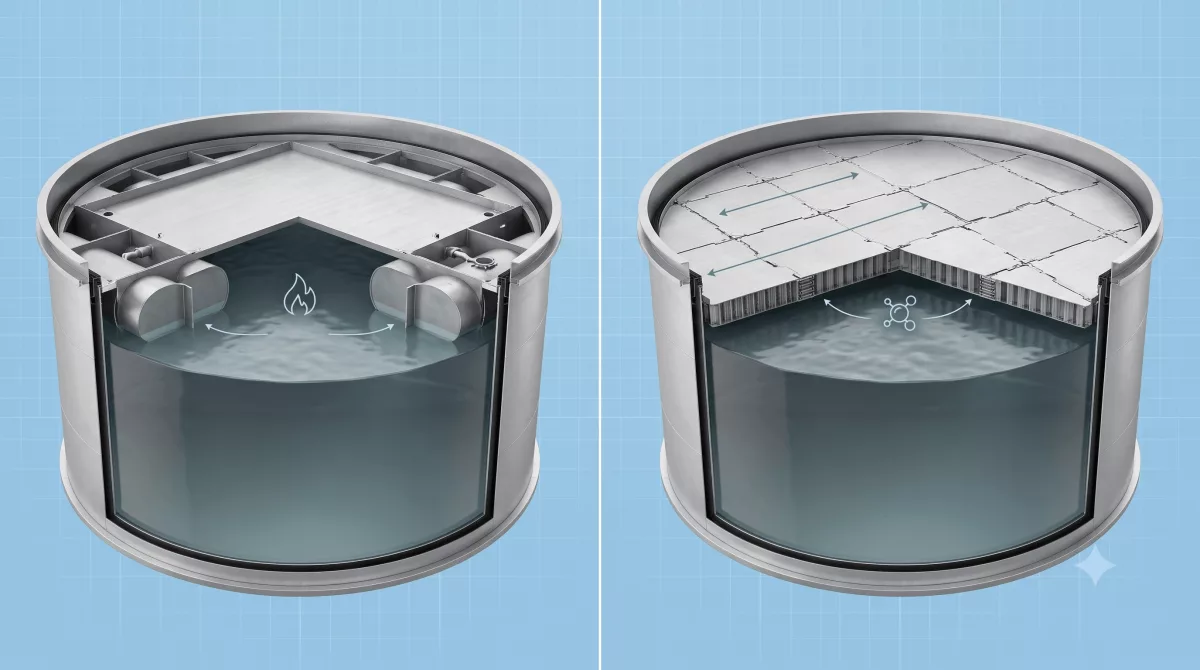
Pontoon versus full-contact roof
A pontoon roof may be considered when
- A lightweight modular structure is preferred.
- Internal assembly is required.
- Underside access is important.
- The operating conditions suit a pontoon configuration.
- Different rim-seal systems must be integrated.
A full-contact roof may be considered when
- Reducing vapor space beneath the deck is a priority.
- The product is compatible with direct panel contact.
- A modular panel system is preferred.
- The project specification requires full contact.
- The tank geometry permits installation.
No universal solution: stored product, vapor pressure, temperature, tank-shell condition, internal columns, nozzles and applicable standards must be reviewed before selecting a design.
Why the floating roof seal is critical
A floating roof must move freely as the liquid level changes. This requires a gap between the outer edge of the roof and the tank wall.
The floating roof seal closes this annular space while allowing vertical movement.
Its performance depends on maintaining contact despite:
- Shell irregularities.
- Weld seams.
- Changes in rim space.
- Roof movement.
- Product turbulence.
- Temperature changes.
- Mechanical wear.
Primary floating roof seals
Mechanical shoe seal
A metallic shoe presses against the tank shell while a flexible vapor membrane connects it to the floating roof.
Liquid-filled tube seal
A flexible tube filled with a compatible liquid adapts to the annular space and follows the tank wall.
Pantograph seal
A pantograph structure applies pressure that allows the sealing element to follow variations in the shell.
Seal selection should consider product compatibility, rim-space variation, shell condition, installation method and inspection access.
Secondary and external floating roof seals
A secondary seal is installed above the primary seal. It adds another barrier across the rim space and can help protect the primary system from weather, debris and direct exposure.
Secondary seals may be relevant when:
- Required by the applicable regulation.
- The tank stores volatile products.
- The primary system needs additional protection.
- Emission-control performance must be improved.
- The tank is being upgraded during maintenance.
- Rim gaps need better coverage.
How a compression plate seal works
A compression plate seal uses flexible or sprung metal plates that press a sealing membrane or lip against the tank wall.
The plates accommodate movement and variations in the shell while maintaining distributed contact around the tank circumference.
- Tank diameter.
- Available rim space.
- Shell irregularity.
- Roof movement.
- Stored product.
- Chemical resistance.
- Wind and weather exposure.
- Installation constraints.
- Inspection requirements.
- Replacement strategy.

Internal floating roof seals
Internal roofs also require a seal around their perimeter.
Possible configurations include:
- Mini-shoe primary seals.
- Flexible primary seals.
- Foam-filled seals.
- Wiper secondary seals.
- Column seals.
- Flexible gaiters.
The engineer should also review:
- Column seals.
- Ladder wells.
- Gauge poles.
- Roof legs.
- Deck penetrations.
- Anti-rotation devices.
- Pressure-vacuum behavior.
- Fixed-roof ventilation.
The role of an aluminum geodesic dome
An aluminum geodesic dome is a self-supporting fixed cover formed by a triangulated structural system.
When installed above an internal floating roof, the dome can:
- Protect the roof from rain and snow.
- Limit water ingress.
- Reduce exposure to wind and debris.
- Remove the need for internal roof columns in many designs.
- Provide a lightweight cover for existing tanks.
- Support modular installation.
- Reduce weather-related maintenance.
Different components, different functions
- The dome provides the fixed upper enclosure.
- The floating roof follows the product level.
- The seal closes the rim space.
- The fittings control openings and penetrations.
The complete system should be engineered together rather than specifying each element independently.
Benefits of an integrated roof, dome and seal system
Reduced evaporation losses
The floating roof reduces the open vapor space while seals limit vapor movement around the perimeter.
VOC emission control
Floating roofs and high-efficiency seals are established techniques for volatile-liquid storage.
Product protection
A fixed aluminum dome can reduce exposure to rain, snow and external contamination.
Lightweight construction
Aluminum can be beneficial in retrofit projects, subject to a structural assessment of the existing tank.
Modular installation
Components may be transported in sections and assembled at the storage tank.
Adaptability
Roof, dome and seal systems can be configured around the tank and stored product.
Information required before specifying a system
- Tank dimensions. Diameter, height and operating levels.
- Existing roof. Fixed, external floating roof or existing dome.
- Tank construction. Shell material and applicable construction standard.
- Stored product. Composition, aromatic content and vapor pressure.
- Operating conditions. Temperature and minimum and maximum liquid levels.
- Tank geometry. Out-of-roundness, internal columns and supports.
- Fittings. Nozzles, gauge poles, ladders, legs and penetrations.
- Existing seal. Type, condition and available rim space.
- Environmental loads. Wind, snow and seismic conditions.
- Access. Manholes, lifting restrictions and installation area.
- Shutdown plan. Whether the tank can be taken out of service.
- Regulatory framework. Environmental, safety and inspection requirements.
Retrofit considerations
Installing a new aluminum floating roof or seal in an existing tank requires more than checking the nominal diameter.
The assessment should examine:
- Shell deformation.
- Internal obstructions.
- Existing corrosion.
- Roof clearances.
- Tank-bottom condition.
- Access through the manhole.
- Removal of old components.
- Hot-work limitations.
- Ventilation and confined-space procedures.
- Installation while in service or out of service.
- Compatibility with the fixed roof or dome.
- Future inspection access.
Project-specific feasibility: modular construction can facilitate retrofit projects, but tank geometry, safety procedures and installation access must still be verified.
Inspection and maintenance
Floating roof performance can change over time due to mechanical wear, chemical exposure and tank-shell movement.
Inspection should consider:
- Visible seal damage.
- Rim gaps.
- Membrane condition.
- Plate deformation.
- Shoe contact.
- Loose fasteners.
- Pontoon integrity.
- Panel condition.
- Deck fittings.
- Column seals.
- Drainage.
- Roof level.
- Product above the deck.
- Corrosion or deposits.
The facility should follow the applicable legal requirements, tank standard, manufacturer instructions and site inspection plan.
TAC Enviro storage-tank systems
TAC Enviro publishes a portfolio that includes:
TankPontoon
Modular internal floating roof systems based on buoyant pontoon structures.
TankContact
Full-contact modular floating roof systems for selected industrial storage applications.
TankDome
Self-supporting aluminum geodesic dome systems for new tanks and retrofit projects.
TankSeal
Primary, secondary and tertiary sealing systems for internal and external floating roofs.
Tank accessories
Drainage, suction, covers, coatings and additional storage-tank components.
Project-specific engineering
Configuration according to tank geometry, product data and operating requirements.
Choosing aluminum floating roofs as a complete system
The effectiveness of an aluminum floating roof depends on more than the deck material. The roof type, rim seal, fittings, dome, tank condition, stored product and inspection strategy must be evaluated together.
Industrial operators considering aluminum floating roofs, geodesic domes and sealing systems can review TAC Enviro’s product portfolio or contact its sales team with the project data.
Technical note: final roof, dome and seal selection must be based on project-specific engineering, product compatibility, applicable standards and local regulatory requirements.
Frequently asked questions
What is an aluminum floating roof?
It is a lightweight internal roof that floats on or close to the stored liquid and moves vertically as the tank level changes.
What is the difference between a pontoon and a full-contact roof?
A pontoon roof uses buoyant compartments connected to a deck. A full-contact roof places most or all of the underside directly against the liquid.
Do floating roofs eliminate all emissions?
No. Emissions can still occur through rim gaps, fittings, penetrations and damaged components.
What is a primary floating roof seal?
It is the first sealing device installed between the roof edge and the tank wall.
What is a secondary seal?
It is an additional seal installed above the primary seal to provide another barrier across the rim space.
What is a compression plate seal?
It is a sealing system that uses flexible or sprung metal plates to press a sealing lip or membrane against the tank shell.
What is an external floating roof seal?
It is the perimeter sealing system installed between an external floating roof and the wall of an open-top storage tank.
What is an internal floating roof seal?
It is the perimeter seal installed between an internal floating roof and the shell of a fixed-roof or domed tank.
Why install an aluminum geodesic dome?
A dome protects the internal roof and stored product from weather while providing a lightweight, self-supporting fixed cover.
Can a floating roof be retrofitted?
Many systems can be retrofitted, but tank geometry, structure, access and internal components must be assessed first.
Are aluminum floating roofs suitable for every chemical?
No. Compatibility must be confirmed for the stored product, vapor composition, temperature and roof materials.
How often should seals be inspected?
The frequency depends on the applicable regulation, tank standard, product and facility inspection plan.
What information is needed for a quotation?
Tank dimensions, product data, roof configuration, rim space, internal fittings, environmental loads and installation constraints are normally required.
How can TAC Enviro be contacted?
TAC Enviro can be contacted by telephone at +34 954 214 896 or by email at sales@tacenviro.com.